

Climate and Concho
C&A Tribes join with nonprofits, universities in bison study funded through USDA grant

When folks around here think of agriculture research, Fort Reno probably comes to mind.
The USDA has been operating there for decades and recently has been making headlines because the Cheyenne and Arapaho Tribes continue to argue the land rightfully belongs to them.
Congressman Frank Lucas apparently doesn’t agree and had language inserted in this year’s proposed Farm Bill that would allow that to happen, never.
This is according to reports by The Hill as well as NonDoc, both online news organizations in Washington, D.C., and Oklahoma City, respectively.
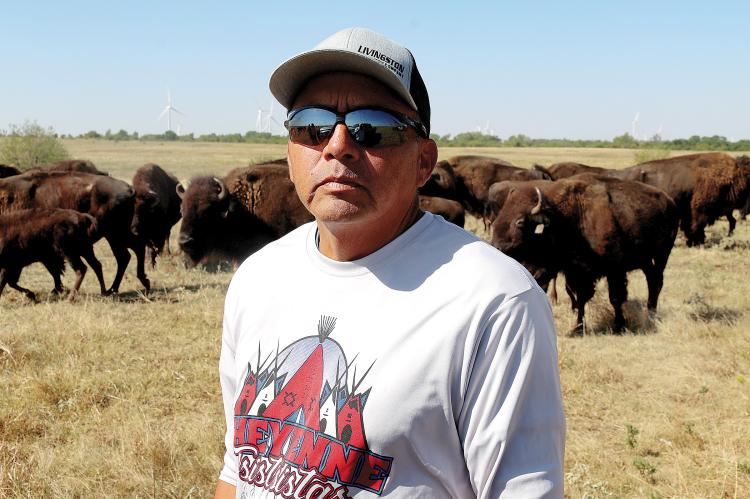
But while the Fort Reno ownership debate smolders, just to the north on the more than 6,000 acres known as Concho, the Cheyenne and Arapaho are partnering with researchers from around the nation on the study of bison.
It’s research that sounds somewhat similar to what’s being conducted at Fort Reno, at least in the areas of climate and agriculture.
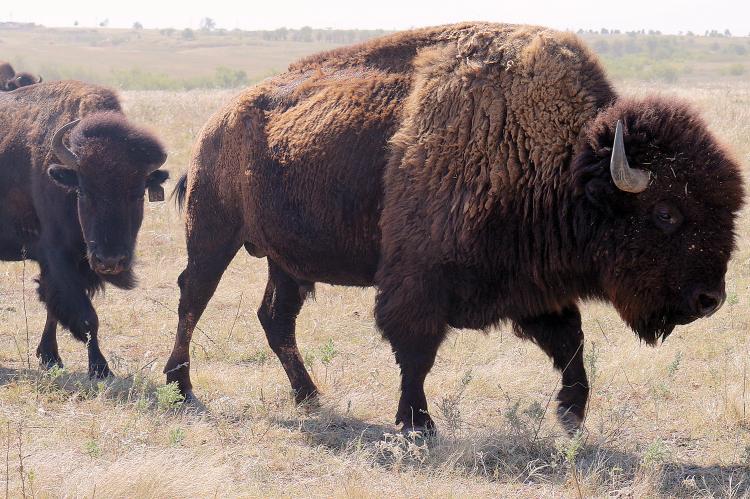
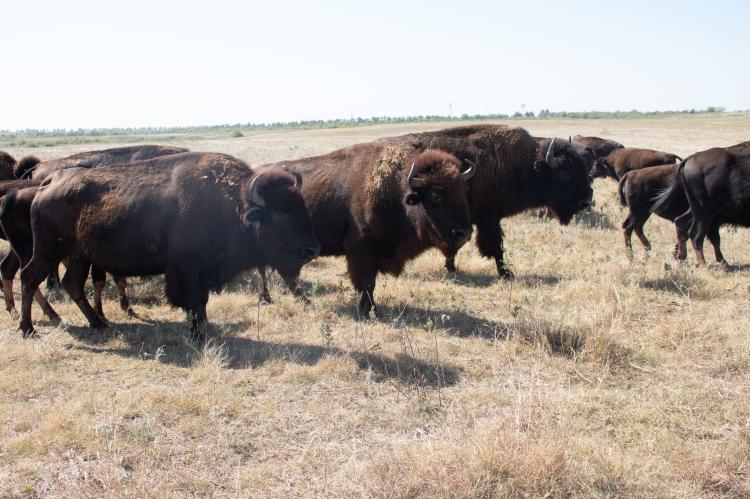
At Concho, the focus is on how bison could have a positive impact on the climate and eventually become a source of income for Native American tribes. Apparently, the natural grasses and plants the bison like to graze on help trap carbon back into the soil. And the lean meat produced by bison could offer a healthy food alternative.
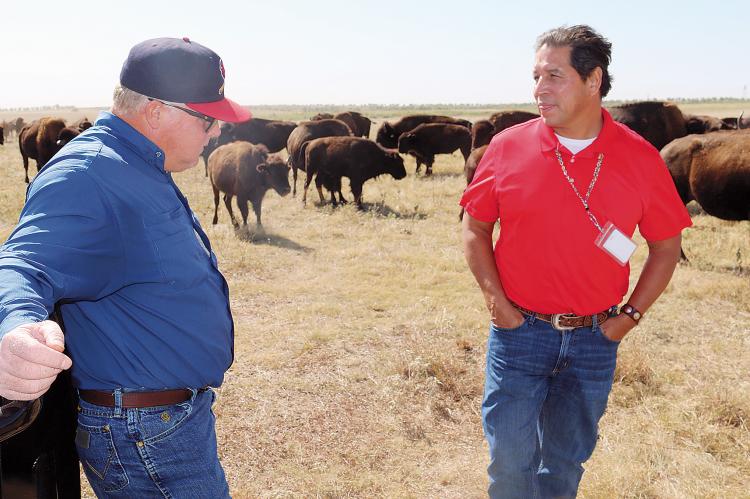
Tony Maldonado serves as Business Director for the C&A. He works closely with Ryan Long, a graduate from the School of Agriculture at Oklahoma State University and the C&A ranch manager. Randy Hawk, director of Bison Management, completes the C&A leadership team.
The trio are often involved in zoom meetings with scientists and researchers from entities such as Brown University and the University of Wisconsin as well as other Native American tribes and nonprofits dedicated to agriculture and climate research. The C&A are part of a $7 million USDA grant project focusing on Regenerative Tribal Buffalo.
The program is coordinated through the C&A along with nonprofit organizations, one known as Collaborative Earth, the other Mad Agriculture.
The goal of the research, according to the partners is to “create a compelling demonstration of the ecological and economic outcomes of regenerating diverse and resilient grasslands supporting – and supported - by well-managed herds of buffalo.”
Originally, the grant for the study was $14 million, but Maldonado said it was cut in half. The reason why is unknown.
Still, the funds support the four-year study of the some 320 bison that roam Concho, grazing on the natural plants and forage of the area.
Long said buffalo are a lot like goats, they like to graze on whatever is available.
“Redlands would understand this,” he said, referring to the goat research program Redlands Community College developed years ago.
He said bison are actually easier to work with than cattle. He said bison tend to follow the herd, so if one moves in a certain direction, the rest normally follow. Sometimes, cattle can require a bit of a push, Long said.
Two Flux Towers are stationed in a pasture at Concho. The towers are high-tech contraptions that study the soil and measure the impact the buffalo have in helping to capture carbon emissions through the natural process. Bison eats. Bison poops. Repeat the process.
Hawk, who has been with the C&A bison program for more than 15 years, said southern bison have issues the herds farther north are not exposed to. He said the heat of the Oklahoma plains allows for more parasite problems to spring up.
“They (bison) don’t have these problems in Colorado or Montana,” Hawk said.
Hawk said he often is sending bison fecal samples to Texas A&M University for analysis and recommendations on how to combat a particular parasite.
Hawk said the Flux Towers are dependable and only require routine cleaning and maintenance.
Long said cattle in the southern plains are exposed to the same kinds of parasites as bison, but have built up immunity not yet established in the buffalo.
The program is in its early stages. And it’s not the first time the C&A have partnered with the USDA on agriculture-related research.
In 2017, the C&A entered into what the USDA's Natural Resource Conservation Service described as a “landmark soil health agreement to establish a demonstration farm showcasing advance soil-health techniques.” The agreement was the first of its kind between the NRCS and an Indian tribe, information from the USDA said.
C&A Gov. Reggie Wassana has said if Fort Reno is returned to the tribes, the USDA could keep the research operation it has there. He said the research could actually expand.
According to a USDA website, 27 people are employed at Fort Reno.
A study the C&A had conducted by a Chicago-based firm that specializes in economic development said the tribes could create close to 3,000 jobs if their plan to develop the property was allowed to move forward.
But that will take action from Washington, D.C., and although some high-ranking officials from the USDA recently toured Fort Reno and Concho with Wassana and others, there has been no indication the land will be returned to the tribes.
As for the bison, Long said the research being done at Concho will spill over into the cattle operation run by the C&A at its ranch in Hammond. While the animals are different, much of the research has similarities.
Long said with 18,000 acres in agriculture and production, the C&A are on the cusp of being a major player in Oklahoma farm and ranch operations.
“The potential is unlimited,” he said.
The tribes have land at Canton, Coyle, Concho and Hammond.
Maldonado said the goal is to have bison herds raised through an organic process, never making their way to a feedlot.
This keeps the bison meat lean and produces the kind of results needed to offset negative effects to the climate.
Long said bison meat is well suited for specialty diets, especially for people with diabetes.
Information from the USDA endorses the Concho-based research program.
“USDA is committed to supporting a diverse range of farmers, ranchers and private forest landowners through Partnerships for Climate-Smart Commodities,” the agency said.
“This effort will expand markets for America’s climate-smart commodities, leverage the greenhouse gas benefits of climate-smart commodity production, and provide direct, meaningful benefits to production agriculture, including for small and underserved producers.
“USDA has invested more than $3.1 billion for 141 projects through this effort and all the projects require meaningful involvement of small and underserved producers.
“In this project, we will develop a demonstration program on tribal lands, implementing and expanding multiple climate-smart practices in the production of American bison. This program will showcase the benefits of regenerative bison production to rangeland, ranchers and climate.
“It will increase climate resilience of ranching operations, reduce net greenhouse gas (ghg) emissions, and direct the financial benefits of climate-smart commodity production to ranchers, including tribal groups and early adopters.”
And Long said farmers and ranchers understand things have changed where the climate is concerned. Droughts seem longer and rains seem heavier.
Is that a result of man-made pollution or a weather pattern that could have existed a few hundred years before scientists kept track of such things?
The Concho bison crew are certain somewhere that question is a focus of study.
“Everyone is doing some kind of research,” Long said.