

Analysis: Fort Reno research appears to be more of a partnership affair
Universities, others heavily involved in producing agriculture findings
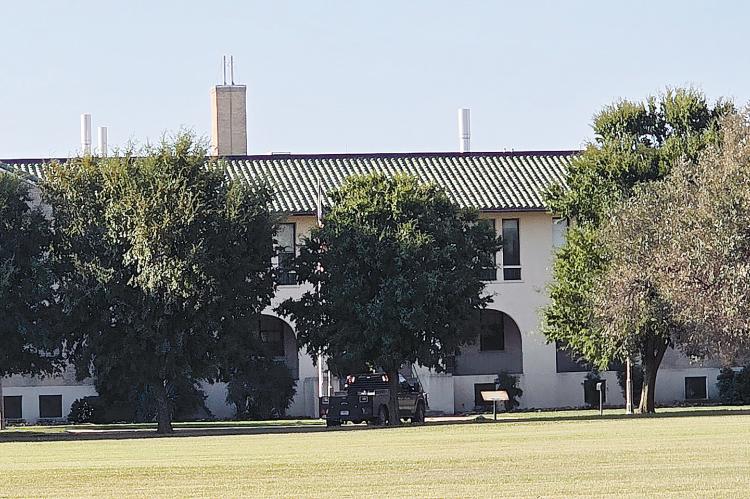
On paper, the USDA’s Grazinglands Research Laboratory at Fort Reno is a place; an historic tract of land west of Oklahoma City where scientists study cattle, forage and water in the Southern Plains.
In practice, much of its research happens somewhere else.
An analysis of three years of USDA Agricultural Research Service publications associated with Fort Reno — April 2023 through March 2026 — shows that only a small share of that work depends directly on the site itself. Most is conducted across a broader network of universities, laboratories and field locations spanning Oklahoma, the United States and, in some cases, the globe.
The findings suggest Fort Reno functions less as a standalone research site and more as a node in a distributed scientific system.
CityNews commissioned the analysis ahead of a US House vote that would permanently block a return of the Fort Reno property to the Cheyenne and Arapahoe Tribes of Oklahoma.
Legislative leaders have said a vote on the 2026 Farm Bill, formally called the Farm, Food, and National Security Act of 2026 (HR 7567), could come this week. The bill includes a provision to keep the 6,700-acre facility from ever being declared surplus property and eligible for return.
A minority of site-based research
Across roughly 190 publications reviewed, about 11 percent relied heavily on Fort Reno itself — using its land, long-term datasets or experimental infrastructure as a central component of the research.
Another 28 percent incorporated Fort Reno as one of several contributing sites or data sources.
The majority — about 61 percent — involved work conducted primarily elsewhere. That includes laboratory studies, modeling projects, multi-state collaborations and international research where Fort Reno appears only as an institutional affiliation.
In some cases, Fort Reno–affiliated scientists contributed to studies conducted in places as far away as China, Brazil and Argentina.
The distinction matters because it raises a basic question: What role does Fort Reno actually play in the research it helps produce?
The dataset also shows Fort Reno’s output is deeply tied to partnerships, particularly with Oklahoma universities.
Researchers from Oklahoma State University appeared in more than 100 publications, followed by the University of Missouri and the University of Oklahoma. Other collaborators included Texas A&M University, Kansas State University and a range of international institutions.
Rather than operating as a self-contained research station, Fort Reno researchers appear to anchor a collaborative network that extends well beyond its physical boundaries.
That structure reflects broader trends in agricultural research, where large-scale questions — from climate variability to water use to crop genetics — increasingly require multi-site data and cross-institutional teams.
The work itself is also concentrated among a relatively small group of researchers, each of whom contributed to multiple projects across different research areas.
Their work spans disciplines such as hydraulic engineering, livestock systems, climate modeling and ecosystem monitoring — fields that often rely on regional or national datasets rather than a single site.
What Fort Reno contributes
Even within a distributed system, Fort Reno still plays a distinct role.
The site supports long-term watershed and grazing studies, including work tied to the USDA’s Long-Term Agroecosystem Research (LTAR) network. These projects track changes in soil, water and vegetation over time.
Those efforts make up a relatively small share of total publications, but they represent some of the most place-dependent work in the portfolio.
At the same time, much of the broader research — particularly modeling and lab-based studies — could be conducted without direct reliance on the site.
Fort Reno’s evolving role
The Cheyenne and Arapaho Tribes have long maintained the facility should have been returned to them once it stopped being used by the US Army. The post was established in 1874 and served as a base for cavalry troops, and later was a remount station where horses were bred and trained. As diesel engines replaced horses in the military, the government turned it over to the USDA in 1948.
US Rep Toby Morris sponsored legislation in 1949 to return the land, less a portion that had been turned over to the Bureau of Prisons for the Federal Correctional Institution at El Reno in 1937. The measure passed in the House but failed in the Senate.
A 1994 Congressional Research Service report recommended closing the Fort Reno facility, citing lower research productivity compared with other sites and suggesting similar work could be conducted elsewhere at lower cost.
The report noted that average annual funding in 1992 for the El Reno facility amounted to $1.7 million. A congressional appropriation of $180,000 for wheat pasture research at an Oklahoma State University facility in Marshall, Oklahoma, in fiscal year 1995 appears to support similar work. Critics cited the contrast in past policy discussions about whether similar research could be done elsewhere at a lower cost.
However, the structure of agricultural research has shifted significantly in the decades since, with greater emphasis on multi-institutional collaboration, long-term data networks and modeling that often extends beyond a single site. The recent analysis suggests that shift is reflected in Fort Reno’s current output, where much of the work is conducted across a distributed network of universities and research partners rather than at a single physical location.
Language to prevent the Fort Reno site from becoming subject to disposal under surplus property provisions was first inserted into legislation in 2008, when it was added to that year’s farm bill. Subsequent measures have extended the temporary measure.
This year’s Farm Bill, which passed out of committee by a 34-17 vote earlier this year, would make permanent what had been temporary blocks on transfer to the tribes. If the measure passes in the full House, it would move on to the Senate for approval there.
The analysis
The analysis reviewed 189 USDA Agricultural Research Service publications associated with Fort Reno between April 2023 and March 2026, categorizing each based on whether the research relied on the Fort Reno site, incorporated it as part of a broader system or was conducted elsewhere.