
McVay announces candidacy for state school superintendent
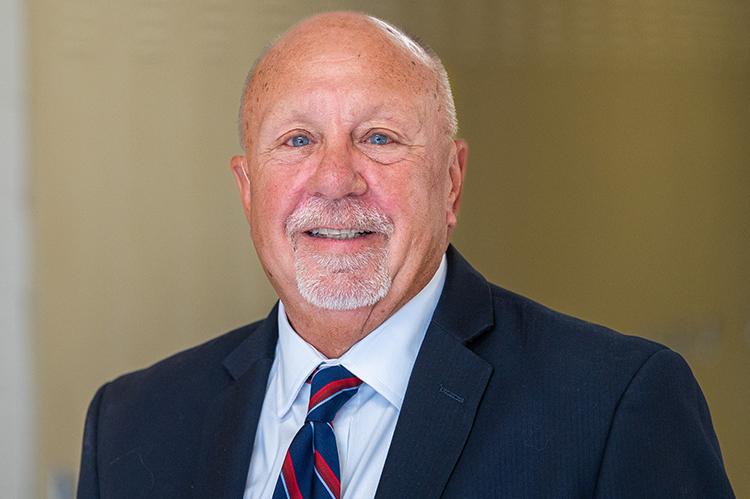
Craig McVay admits he “bought into” the idea that using technology and other “scientific” based models to educate young children was better than first making sure they could read and write.
He now knows that was a mistake. He’s on a mission to correct it.
As he announced his candidacy for state school superintendent this week, McVay said if he’s elected, Oklahoma will return to the basics, especially when it comes to early childhood education.
It will be “A, B, C’s and 1, 2, 3’s,” McVay said.
“Instead of picking up the iPad, students are going to pick up the writing pad,” he said.
The former El Reno Public Schools superintendent said he was approached by state Democratic lawmakers to run for the superintendent position. Initially, he had no intention of running.
At 66, he is retired and “I was not looking for a job.”
But as time went on, he said he realized he could longer sit on the sidelines.
McVay said he had made up his mind to run for the post before Ryan Walters announced he was resigning.
“My wife looked at me and she said, ‘You know you’re going to do it.’”
McVay is the polar opposite of Walters, who was often highly critical of public schoolteachers, especially those he said were trying to indoctrinate young minds with liberal, or left-leaning, ideology.
Walter’s resignation was celebrated by many within the Oklahoma education establishment.
Himself a former history teacher and coach, McVay is an avowed champion for the Oklahoma public schoolteacher. He said Oklahoma must return to having certified teachers in the classroom and they must be paid. He said recent reports that show Oklahoma ranks 50th in education must serve as a wake-up call.
“Oklahoma is $1.2 billion below the regional average in per pupil spending,” McVay said. He called that unacceptable. He knows he will be criticized for advocating for more education funding.
He wants the state to tap into its reserves, often referred to as the “Rainy Day Fund” to help pay teachers more and to bring on additional teachers so class sizes can be reduced. He said early childhood classes should have no more than 15 students.
“If being 50th in the nation in education isn’t a rainy day, I don’t know what is,” he said.
Limiting class sizes to 15 students in early childhood would require many districts to have to build more classrooms. Many of the rural schools could hit the target, but the larger districts would need to build more space. Still, McVay said the districts he has spoken with tell him they will find a way to get it done.
McVay is not a cheerleader for standardized tests. He knows people learn in a variety of ways and mandated tests do not show the true abilities of a person. But convincing lawmakers that education is more than standardized tests will be a tall order.
“There are people who make a lot of money when we fail,” McVay said, referring to the publishing companies that provide states with test materials.
“That’s a powerful lobby. Oklahoma spends, I think, about $20 million per year on tests.”
McVay wants extra state funding to tap into what he says is an army of retired teachers. He said most of them do not want to come back to the responsibilities of full-time teaching, but he said many would return if their only duty was to prepare students for taking the standardized tests.
He envisions retired teachers “taking a dozen or so” students and helping them better prepare for test-taking. He points to Mississippi as a state that has seen its test scores rise to the point it’s now referred to as the “Mississippi Miracle.”
McVay is pleased with Oklahoma’s move to ban cellphones from classrooms. He said students must learn how to read and write as well as attain basic math skills without relying strictly on technology.
“If I want to spell the word encyclopedia, all I have to do on my phone is plug in e, n, c, y and the word pops up,” he said.
While that kind of tool is great for adults already in the workforce, he said it serves only to make students lazy.
“We’ve all become lazy,” McVay said.
He said it’s time to correct this and instill in students a love for learning and the process that is required.
McVay said he is aware of the challenges running as a Democrat in a state dominated by Republicans brings, but he’s convinced people are not looking for a partisan leader when it comes to education.
“I’m a one-issue voter, education,” McVay said.
He said if elected, he would work closely with Career Tech and community colleges as well as the Regional university system to create a new teacher incentive program. He said it would be modeled after what Oklahoma’s medical community did when it faced a nursing shortage.
He said El Reno implemented a program, partnering with Oklahoma Christian University during his tenure as superintendent. Students at the university received tuition assistance when pursuing an education degree. After graduation, they committed to working so many years for the local district.
McVay said it was an eye-opener when he spoke in December to a graduating class of educators at the University of Oklahoma and 52 of the 55 class members had already accepted teaching jobs in Texas.
“Only three of that graduating class planned to remain in Oklahoma,” McVay said.
He said that must be turned around. He said Oklahoma has to keep its best and brightest from leaving.
Oklahoma has to reinvent its system of education and it must do that by going back to what works, McVay said. He said what works best is “literacy. Kids have to learn to read and write.”