

C&A Tribes host Fort Marion Symposium
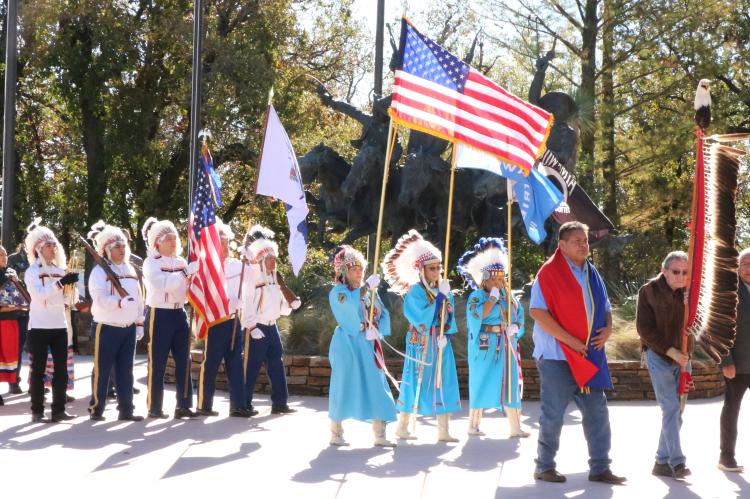
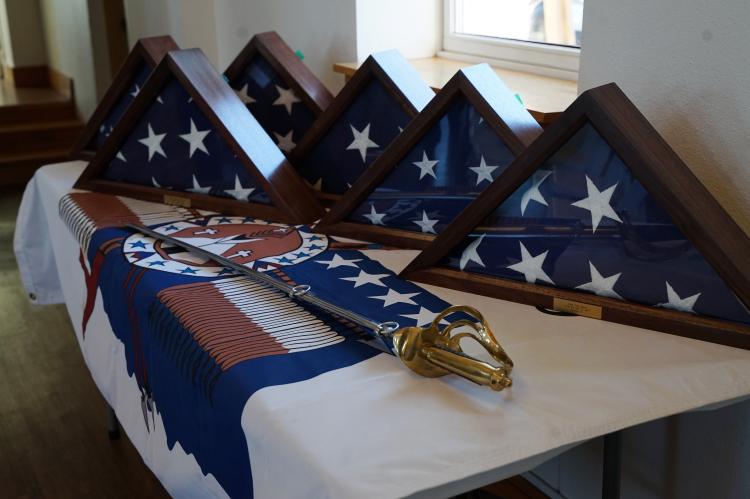
In November, the Cheyenne and Arapaho Tribes hosted the three-day Fort Marion Symposium. The symposium is a tribute to the plains warriors and an effort to keep alive the history.
The symposium opened on the site of the Washita Battlefield National Historic Site in Cheyenne.
Traveling to Concho, the second day was held at the Darlington Chapel/Darlington Agency. On the third day, the event moved to Oklahoma City and the National Cowboy and Western Heritage Museum.
A welcome was given by Cheyenne and Arapaho Tribes Lt. Gov. Hershel Gorham.
“The history and policy of the United States government has had with Native Americans has not always been kind, you all know that, and one of the reasons why we continue to hold projects and symposiums like Fort Marion is so that we never forget that history and the atrocity that has occurred in the past with Native Americans and that we learn those things so that we can pass those on, the oral history, the written history on to our younger generations,” Gorham said.
History of Fort Marion
In the early 1800s, the discovery of gold in the Rocky Mountains and Black Hills led to the invasion of Cheyenne and Arapaho homelands. These tribes faced increased encroachment from settlers moving westward under the doctrine of Manifest Destiny, resulting in conflict as settlers disrupted the bison migrations crucial for the tribes’ survival.
The Cheyenne and Arapaho, along with other southern tribes, resisted forced relocation during the Red River War, which began in 1874. However, by 1875, depleted in resources and strength, they surrendered, marking the end of their autonomy on the plains. Following the conflict, military leaders including Gen. Phillip Sheridan ordered the incarceration of key tribal leaders, a decision that President Ulysses S. Grant disregarded despite its illegality. This led to the separation of leaders from their families, their homelands and their life on the plains.
At the Cheyenne Agency in Darlington, Lt. Col. Thomas H. Neill selected 33 Cheyenne and two Arapaho leaders guilty of crimes for imprisonment, often based on unreliable testimonies. An additional 18 warriors were randomly selected to fulfill a quota, resulted with all being confined at the guardhouse prior to train transport to Fort Marion, Florida.
On April 6, 1875, while prisoners were being shackled for their journey, Cheyenne women chanted war songs. A prisoner named Black Horse, while attempting to escape was shot, prompting fears of retaliation that led many to flee. Cheyenne warriors managed to repel U.S. troops but Col. Neill, equipped with a Gatling gun, the first reported use of such a weapon west of the Mississippi, ultimately ordered a retreat. Some Cheyenne men escaped, while many women returned to the agency seeking amnesty offered by Gen. John Pope.
Under Capt. Richard Henry Pratt, notorious for advocating forced assimilation, the selected individuals were on display as “captured savages” for profit while en route to Florida, but never received compensation. Upon arrival, the individuals had their traditional attire stripped and their long hair cut, violating significant cultural norms. They were compelled to learn English and adopt soldierly behavior, but not treated as actual soldiers. Pratt later supported the creation of ledger drawings by the captive, but they received minimal financial benefit from these works. After three years, the captive had the option to return home or continue their education at Hampton Institute, an experience that influenced Pratt’s establishment of the Carlisle Indian Industrial School and a broader system of forced assimilation for Indigenous peoples.
Today, Fort Marion, recognized as Castillo de San Marcos, is the oldest masonry fort in the United States, located in St. Augustine, Fla. It serves as a memorial to those imprisoned within its walls and the legacy of forced assimilation. Currently, the Cheyenne and Arapaho people are represented by three federally recognized tribes, the Northern Arapaho Tribe in Wyoming, the Northern Cheyenne Tribe in Montana and the Cheyenne and Arapaho Tribe in Oklahoma.
Despite the historical efforts to assimilate them, these tribes continue to uphold their traditions, languages and identity demonstrating their resilience as enduring Indigenous Nations.
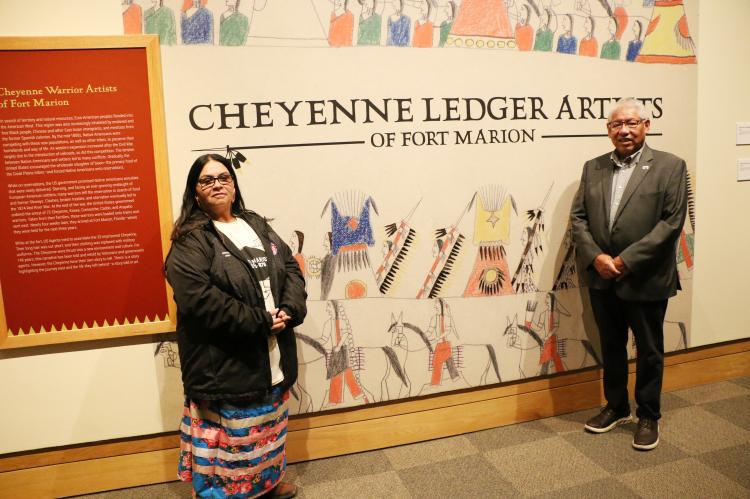
As the symposium continued on its final day, discussions by many, such as Brady Wolf and Amanda Hill on the Wohaw, Kiowa ledger art ensued, and by Gordon Yellowman, who currently serves as the tribal historian for the Cheyenne and Arapaho Tribes Department of Language and Culture. Yellowman discussed the interpretations of ledger drawings. Following his discussion, Yellowman, along with Eric Singleton, curator of ethnology, guided attendees to view the ledger drawings and shield exhibit located inside the museum. The ledger drawings depicted art that was drawn by the Cheyenne that were held captive at Fort Marion.
“This ledger art exhibition of Fort Marion ledger artists was part of an exhibit that we decided to do because we originally started at the Cummer Museum in Jacksonville, Fla., and then from there it went to Albany, Texas, to the Old Jail House Art Center,” Yellowman said
As a traveling exhibition, it expanded from there, but Yellowman said the exhibit needed to be showcased during the symposium. And so, the exhibit was brought to the National Cowboy and Western Heritage Museum, to honor the ledger drawings and the ledger artists themselves.
The exhibit first opened Sept. 17 and will close on Jan. 5, 2025, as one of the longest exhibitions on Cheyenne and Arapaho material. For the exhibition to be brought to Oklahoma, Yellowman said is significant as it can be compared to hidden treasures in the basement.
“There’s life to these drawings, there’s a life to what we call ledger art and you got to be mindful of the ledger artists that made this art and then in our Cheyenne and Arapaho community, all of us are descendants of those artists,” Yellowman said.
As the artists were sometimes referred to as prisoners of war at Fort Marion, Yellowman said the only way to get tribal citizens to see the drawings was to put on the exhibition as an awareness, as education and a value system.
“They can appreciate the work that their relatives done but also to showcase them in their own community and so this is the perfect venue for that if we had our own museum, which we eventually will, then we can have these kinds of exhibits and when they can see that art, it’s art but it’s also a narrative story of that person that produced that piece of art,” Yellowman said.
Another focal piece of the exhibit was the showing of the Little Rock shield that had belonged to Chief Little Rock, a minor council chief of the Wutapiu band of Southern Cheyenne. It was during the Washita Massacre that occurred on Nov. 27, 1868, that Lt. Col. George Armstrong took Little Rock’s shield.
“Custer picked up that shield at the battle site as he burnt the village, he went into Little Rock’s teepee, he picked up that shield and took it and then he took it back east and he gifted it to the Detroit Institute of Art, and that’s where it sat all this time,” Yellowman said.
Yellowman said they wanted to make it part of the story, with the Washita, Custer, the Cheyenne and Little Rock.
“Let’s showcase this shield along, bring it as close to home as we can for the lineal descents to see,” Yellowman said.
A direct ancestor to Little Rock, Memo Valenzuelo, a Cheyenne and Arapaho youth, said seeing the shield in person was surreal.
“They lost the battle of Washita, so General Custer took that shield back with him and so it’s been out of our hands for over 150 years and now we have it. Little Rock’s my direct ancestor, he was a Cheyenne Chief and now’s my first time seeing it today, so it’s pretty cool,” Valenzuelo said.
Having been involved with the Fort Marion symposium and events the last two years, Valenzuelo said the work is important as it’s publicly taking a stance on telling the truth of history.