

When did we start paying companies to come here?
Oklahoma voters face a modern question in SQ 844 with surprisingly old roots
Next week, Oklahoma voters will be asked to decide a question that sounds remarkably technical.
State Question 844 concerns the way the state reimburses schools, counties, libraries and other local governments for property taxes they don’t receive from qualifying manufacturers.
If your eyes glazed over somewhere in that sentence, you’re probably not alone.
But underneath the language of ad valorem taxes and reimbursement formulas is a much more interesting question. When did we start paying companies to come here?
The short answer is: a long time ago.
Communities have been competing for economic development almost as long as there have been communities. In the 19th century, towns competed fiercely for railroads. A railroad could determine whether a town prospered or withered. Communities offered land, rights of way, bonds and other inducements to persuade railroad companies to lay their tracks through one town rather than another.
The reasoning was straightforward.
Getting the railroad wasn’t merely about getting trains. It meant access to markets.
Farmers could ship crops and livestock. Merchants could receive goods. Travelers could arrive. Businesses could locate nearby.
A town might give something away because leaders believed what came afterward would be worth more.
Sound familiar?
The things we offer have changed. The basic proposition hasn’t.
Today, instead of trying to attract a railroad, states and cities compete for factories, corporate offices, warehouses, aerospace companies, data centers and other major employers.
Instead of donating a railroad right of way, governments offer tax exemptions, rebates, infrastructure improvements and other incentives.
The argument remains essentially the same: Give up some revenue today in exchange for economic activity tomorrow.
Oklahoma formally embraced one version of that idea in 1985. That year, voters overwhelmingly approved State Question 588, creating a five-year property-tax exemption for qualifying new, expanded or acquired manufacturing facilities.
There was an important catch.
Property taxes don’t primarily belong to the state. They support local institutions, including public schools, county governments, CareerTech districts, libraries and other services.
So Oklahoma made another promise.
The manufacturer would receive the exemption, but the state would reimburse local governments for the revenue they lost.
For a while, that arrangement probably seemed fairly straightforward.
Then the definition of the kinds of businesses eligible for the exemption expanded, and the investments themselves became much larger.
A modern industrial project can represent hundreds of millions or even billions of dollars in taxable property.
The state’s Incentive Evaluation Commission estimated the cost of the five-year exemption at more than $110 million for 2024.
That brings us back to State Question 844.
The measure on the Aug. 25 ballot would not eliminate the manufacturing property-tax exemption. Instead, it would change the constitutional requirement governing reimbursement.
The Legislature would be directed to establish the levels and methods by which local governments are reimbursed for the revenue they lose.
There are legitimate arguments about whether that’s a good idea. But there’s a larger question worth asking regardless of how anyone votes.
Do economic incentives work?
That’s where things get complicated.
Imagine two towns competing for the same factory. The factory promises 1,000 jobs. Town A offers nothing. Town B offers a package of tax exemptions and infrastructure improvements. The company chooses Town B.
Town B’s leaders hold a ribbon-cutting and announce that their economic-development strategy worked.
Maybe it did.
But what if the company would have chosen Town B anyway? Then the incentive didn’t attract the factory. It simply reduced the price the company had to pay for locating there.
That’s the fundamental difficulty with economic-development incentives. We can see the investment that arrives.
It’s much harder to see what would have happened without the incentive.
There’s another complication. Communities aren’t competing in isolation.
If Oklahoma decides it will no longer offer incentives, Texas still can. So can Kansas and Arkansas.
Every state would prefer companies to choose locations based purely on workforce, transportation, energy costs, quality of life and proximity to customers. But nobody wants to be the first state to put down its checkbook while everybody else is still writing checks.
That creates an economic-development arms race.
Oklahoma has participated enthusiastically. The five-year manufacturing exemption is only one example. The state created its Quality Jobs Program in 1993, offering qualifying companies cash rebates tied to new payroll. Other programs reward investment, research, expansion and particular kinds of job creation.
More recently, Oklahoma created the Reindustrialize Oklahoma Act, aimed at enormous manufacturing projects involving billions of dollars of investment and hundreds of new jobs.
The numbers have changed dramatically since towns tried to lure railroads across the prairie. The logic hasn’t.
We give something because we hope to get something bigger. Sometimes that undoubtedly works. A major employer doesn’t merely create jobs inside its own walls. Workers buy homes, eat at restaurants and shop in stores.
Suppliers follow. Construction workers build facilities. New economic activity generates taxes of its own.
But incentives also have costs. A dollar used to attract a new business is a dollar that can’t be spent somewhere else.
And there is an unavoidable question of fairness. The business that’s been operating in Oklahoma for 40 years usually doesn’t get courted. Nobody holds a press conference to persuade the hardware store that’s already on Main Street to stay another decade.
Economic-development incentives are generally designed to reward something new: New investment. New jobs. New facilities.
That makes economic sense.
It can also produce a strange result in which governments work harder to attract the company that isn’t here than to support the businesses that already are.
None of this makes State Question 844 easy.
It shouldn’t.
Public policy becomes difficult precisely when two reasonable ideas collide. Oklahoma wants new investment. Oklahoma also needs schools, counties, libraries and local services. We want to compete for jobs without giving away more than those jobs are worth.
That’s not really a new dilemma. More than a century ago, Oklahoma towns looked toward the horizon and wondered whether the railroad would come their way. They knew the tracks could transform their future. So they were willing to offer something to get them.
Today, the railroad might be a factory, an aerospace plant or a data center. And we’re still asking essentially the same question: How much should the people who are already here pay to persuade somebody else to come?
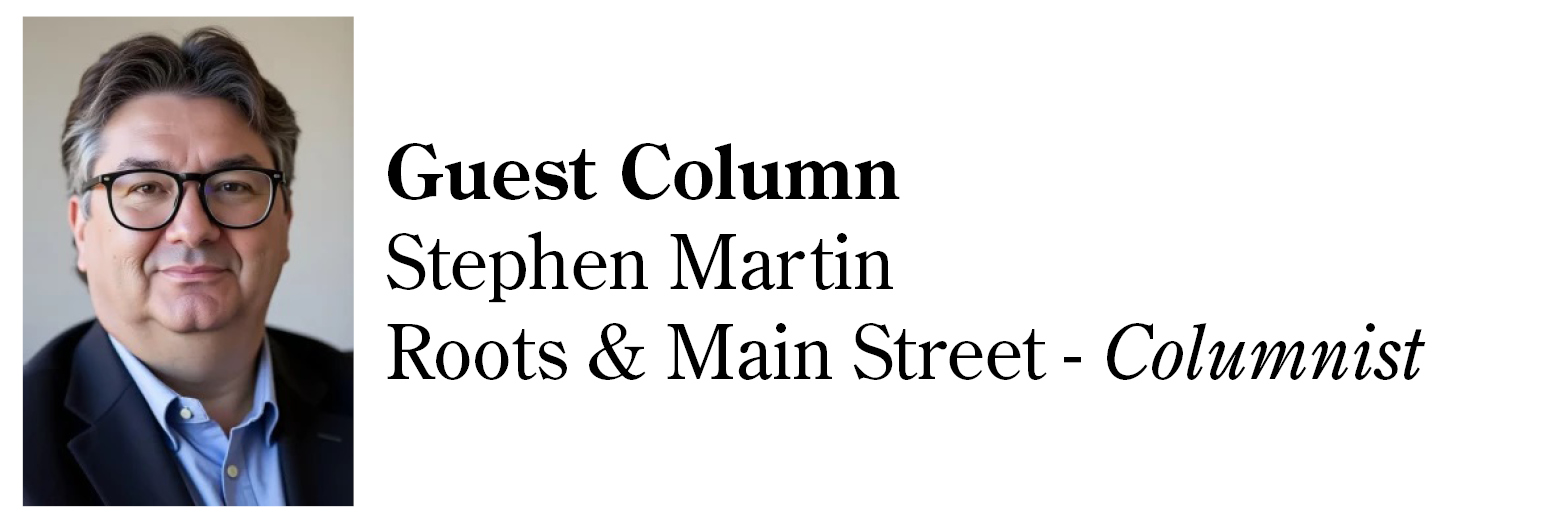
Stephen Martin is an El Reno Tribune contributor and writes a regular column, Roots & Main Street, at https://rootsandmainstreet.substack.com/.